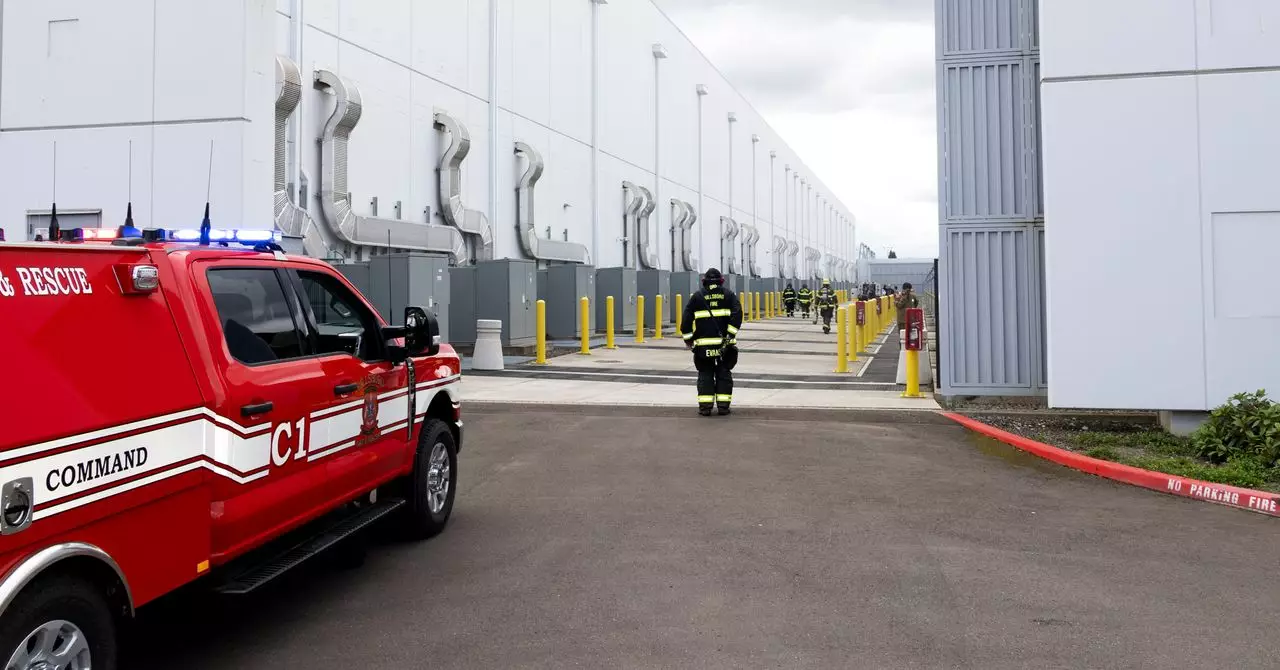
In recent years, the rapid expansion of data centers has transformed the digital landscape, underpinning everything from social media to artificial intelligence. However, this expansion comes with escalating risks that are often overlooked. The incident involving a fire at Elon Musk’s X data center in Hillsboro underscores a disturbing trend: as data infrastructures become more intricate and powerful, so do their vulnerabilities. While fires in such facilities are rare, their potential for devastating consequences warrants more scrutiny. Technology companies and data center operators must reevaluate their safety protocols in the context of accelerating AI demands, recognizing that the very backbone of modern innovation could be its Achilles’ heel.
This blaze exemplifies how high-tech equipment—designed to ensure reliability—can inadvertently become a source of catastrophe. High-density power loads, complex cooling systems, and advanced electrical architectures all contribute to an environment where even minor failures can escalate rapidly. The incident reveals a critical truth: firefighting and safety measures tailored for traditional data centers may not suffice in this new era of explosive computational growth. It’s imperative that industry stakeholders prioritize proactive risk mitigation, investing in smarter, more resilient infrastructure that anticipates potential failures rather than merely reacting to them.
Electrical Systems: The Root of Modern Data Center Fires
The Hillsboro fire investigation points to an electrical or mechanical failure within the UPS system as the likely trigger. The Schneider Electric Galaxy VX uninterruptible power supply, a vital component in maintaining continuous power during outages, became the origin point for the blaze. These systems, while essential, contain large battery packs that are susceptible to failures caused by electrical faults or sudden surges, especially under high-load conditions.
The tendency to underestimate the dangers posed by power backup systems is problematic. Often viewed as safety features, they are, paradoxically, potential fire hazards if not properly maintained or monitored. The fire’s start within the UPS cabinet hints at a broader systemic issue: as data centers scale up, so does the complexity and risk associated with their power infrastructure. Experts warn that insufficient cooling, poor temperature regulation, or overlooked electrical faults can cause components like batteries or circuit boards to overheat, ignite, and ignite a chain reaction that threatens the entire facility.
This incident also raises questions about industry standards. Are current fire prevention strategies adequate for the demands of AI-driven data centers? It appears not. When the fire department struggled to identify an exact ignition source swiftly, it signaled a gap in understanding or managing these complex electrical systems—highlighting an urgent need for improved diagnostics, regular inspections, and enhanced safety protocols tailored to high-risk, high-load environments.
Growing Risks in the Age of Generative AI
AI technology, especially generative models, amplifies the need for colossal computational power and, consequently, larger, more intricate data centers. This surge in demand has an inevitable side effect: pushing the boundaries of traditional infrastructure capabilities. As companies race to deploy more advanced AI, they inadvertently increase exposure to risks like thermal overloads, electrical malfunctions, and fire hazards.
AI requires dense clusters of servers working in unison—something that challenges even the most robust existing systems. Over time, the increased workload can lead to overheating, which exacerbates the likelihood of electrical failures. The problem lies not only in hardware durability but also in the capacity of safety systems to keep pace with the expanding scale. Heavy use of high-capacity batteries, advanced power supplies, and cooling mechanisms intensified by AI workloads can create a volatile environment prone to malfunction.
Furthermore, the industry’s tendency to prioritize uptime and cost efficiency often means cutting corners in safety measures. As a result, fires like the one in Hillsboro should serve as stark reminders: the infrastructure supporting our digital future demands a fundamental overhaul. Building resilience into power systems, deploying smarter fire detection algorithms, and ensuring rigorous maintenance are no longer optional but essential.
What Can Be Done? Advocating for Safer Data Infrastructure
The Hillsboro incident, while unfortunate, provides an opportunity for the industry to reflect deeply on safety practices. It’s clear that existing standards need to be reevaluated against the backdrop of increasingly complex and high-stakes environments. A shift toward holistic safety strategies—integrating real-time monitoring, predictive analytics, and advanced fire suppression technologies—could dramatically reduce the risk of future incidents.
Data centers should adopt more intelligent systems that continuously assess electrical loads, detect early signs of faults, and automatically trigger shutdowns or cooling enhancements before disasters occur. Moreover, transparency and accountability must improve, with operators sharing lessons learned and safety improvements openly. The fact that the operation involved a major cloud and AI backbone signifies that the stakes are higher than ever: a single fire can ripple across multiple sectors, disrupting vital services and costing millions.
Investment in research and development of fire-resistant materials, robust safety protocols, and specialized training is equally critical. Regulators and industry leaders must collaborate, setting stricter standards for electrical installations, maintenance regimes, and emergency preparedness. Only through comprehensive, forward-thinking safety paradigms can we hope to mitigate the risks associated with our growing dependence on AI and big data.
While the Hillsboro fire is but one event, it exposes a broader, systemic challenge: ensuring that our infrastructure keeps pace with technological advancements. The future of digital innovation hinges on our ability to preempt failures, fortify critical systems, and foster a culture of safety that matches the scale of our ambitions. The time to act is now; complacency is a risk we cannot afford.
Leave a Reply