
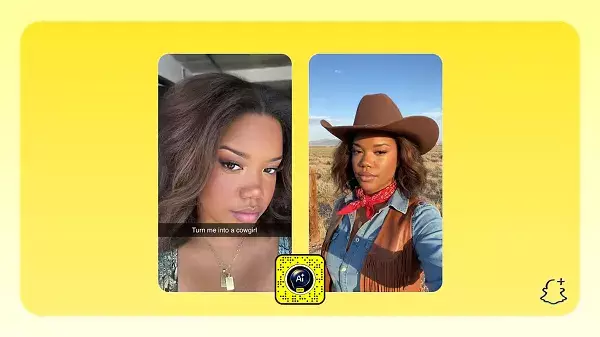
In today’s fast-evolving landscape of social media, the line between reality and imagination continues to blur, thanks to the rapid integration of artificial intelligence. Snapchat’s latest innovation, the “Imagine” Lens, exemplifies this shift by empowering users to conjure vivid images from mere text prompts. This feature marks a bold departure from traditional selfie-centered content, inviting users to venture into highly personalized realms of creative expression. Unlike previous tools that merely offered slight variations of existing images, the “Imagine” Lens opens a portal to endless imaginative possibilities, where one’s digital avatar can transform into astronauts, cowboys, or fantastical beings—all within seconds.
This development underscores a broader cultural phenomenon: the desire for novelty and escapism. Social media platforms historically served as extensions of human experience, allowing users to share authentic moments. Now, however, there’s a growing appetite for curated fantasies that push the boundaries of what we deem possible. With AI-powered image generation, users are no longer confined to their immediate environment but can craft alternative realities that reflect their aspirations, curiosities, or whims. This shift hints at a redefinition of social sharing itself—moving from authenticity towards a curated blend of reality and fantasy.
Does AI Disrupt or Dilute Genuine Connection?
While innovations like Snapchat’s “Imagine” Lens seem exciting at first glance, a critical lens reveals underlying tensions about the essence of social interaction. In a landscape flooded with generated images and surreal visuals, one must question whether these tools facilitate meaningful engagement or merely perpetuate superficial novelty. Authentic connection, rooted in shared experiences and genuine emotion, risks dilution if users increasingly rely on AI to craft idealized personas or adventures.
Furthermore, the use of text prompts to generate images fosters a kind of digital narcissism where the focus shifts from authentic self-expression to the crafting of an idealized or fantastical version of oneself. These images are not real; they are carefully curated illusions that do little to deepen understanding or empathy among peers. Instead, they may create a paradoxical environment where everyone appears more inventive but less genuine, diluting the social fabric that holds communities together.
However, one could argue that this technology also offers new avenues for self-exploration. For example, trying on different styles or imagining oneself in various scenarios can serve as a form of creative therapy or experimentation. Still, such benefits are often overshadowed by concerns about authenticity, potential misuse, and the superficial nature of AI-generated content.
The Future of Creativity: Limits and Opportunities
Snapchat’s move into generative AI signals an exciting frontier—a space where imagination is unlocked with unprecedented ease. But the question remains: is this a step forward or a distraction? On the one hand, AI-driven tools democratize creativity. Anyone with a smartphone can now generate complex images, fueling individual experimentation without the need for artistic skills or expensive equipment. This democratization could herald a new era of personalized art and storytelling.
On the other hand, reliance on such tools also risks stifling genuine skill development. As AI does more of the heavy lifting, users may become passive consumers rather than active creators. The essence of art and self-expression involves effort, authenticity, and a personal touch—elements that can become lost amid the allure of quick, AI-generated visuals. Moreover, as these features become more ingrained in social platforms, there is a danger that aesthetic standards may shift to favor the surreal or superficial, suppressing subtler forms of human creativity.
Ultimately, Snapchat’s “Imagine” Lens embodies the double-edged nature of AI in social media: it can inspire boundless creativity but also threaten the authenticity that makes human connection meaningful. Whether users embrace it as a tool for genuine self-expression or simply as a novelty depends on how these technologies evolve and are integrated into our social fabric.
In this brave new world, one thing is clear—imagination, fueled by AI, will continue to shape how we see ourselves and others, for better or worse.
Leave a Reply