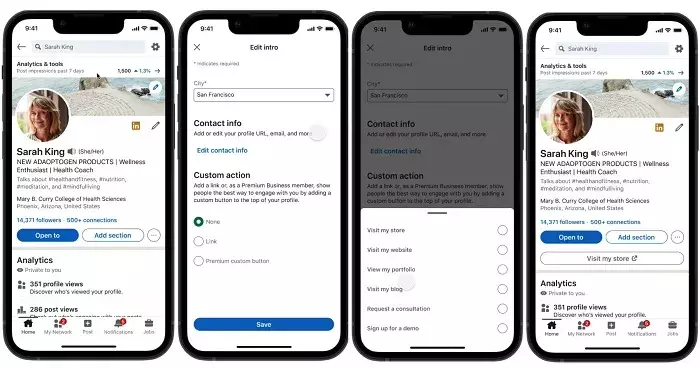
LinkedIn has long been a platform where professionals connect, engage, and network. Earlier this year, the platform introduced a feature allowing Premium subscribers to add custom call-to-action (CTA) buttons to their profiles, enabling them to direct visitors to external URLs, such as personal websites or online stores. However, the recent announcement that these custom links will be removed is a move that has left many in the professional community pondering the implications of this change. While the feature was hailed as a tool for enhancing user profiles, LinkedIn’s decision raises critical questions about its commitment to individual users and the overall evolution of the platform.
Evaluating the Rationale Behind the Removal
LinkedIn’s official statement suggests that its strategy is to continually refine its offerings in the pursuit of maximizing user value. Yet, widely evaluating which features to retain, upgrade, or eliminate raises eyebrows, especially since the company has experienced substantial growth with its Premium services over the years. The claim that custom links were not delivering significant traffic could signal a lack of engagement or innovative uses among users—an assertion that feels somewhat dismissive, considering that personal branding is often a nuanced and subjective endeavor.
Moreover, the idea that LinkedIn seeks to maintain its “SEO potential” by removing dubious links is plausible, but it also underscores a lack of faith in its users to curate their profiles with integrity. What remains troubling is the perception that LinkedIn prioritizes businesses over individuals. While Premium Company Pages receive a significant boost by retaining their CTA capabilities, everyday professionals find themselves sidelined without a critical tool for enhancing visibility in their respective industries.
The Double Standard: Individuals vs. Companies
One of the most striking aspects of this move is the palpable discrepancy between what is available to individual users compared to companies on the platform. With 175 million paying subscribers, individuals should be seen as equally valuable participants in the LinkedIn ecosystem. Instead, their abilities to strategically leverage LinkedIn for lead generation and personal branding are being stifled, at least in terms of CTA buttons. Companies, on the other hand, are rewarded with enhanced engagement opportunities—something that the platform actively promotes as a benefit to businesses.
This reinforces an existing narrative in the professional world wherein individual contributors, freelancers, and entrepreneurs must work harder to gain visibility against corporate entities that inherently have more resources and clout. LinkedIn’s uneven treatment of its user base raises questions about its long-term viability in fostering a diverse and rich professional community. As the platform positions itself as a haven for networking and content-sharing among individuals, the removal of custom links appears wholly counterproductive.
The Landscape of Content Creation on LinkedIn
With LinkedIn actively courting content creators aimed at increasing user-generated content on the platform, the removal of this feature seems counterintuitive. Content creators rely heavily on their profiles serving as a multi-faceted showcase. The absence of custom links restricts their ability to drive relevant traffic and showcase projects or thought leadership effectively. As LinkedIn looks to bolster its content-sharing capabilities, limiting the tools available for individuals impedes the richness and diversity of content that might flow through its channels.
Furthermore, with a burgeoning creator economy and an increasing number of professionals seeking to monetize their expertise, the lack of CTA options could diminish the incentive for users to engage deeply with the platform’s features. LinkedIn must recognize the crucial role that individual user expression plays in enriching the overall community experience.
Looking Ahead: A Call for Increased Value
LinkedIn’s recent maneuvers have left many users yearning for a future that includes not just enhanced features but also robust engagement with individual needs and aspirations. As the platform continues to evolve, it would be wise for LinkedIn to consider offering more comprehensive tools for personal branding rather than merely catering to corporate interests.
If LinkedIn is aspiring to be a thought leader in professional networking, it must preserve features that empower individuals while balancing the needs of businesses. As it stands, removing custom profile links offers a glimpse into a platform that may be misjudging its market—a platform that needs to realign its vision and ensure that the individual user remains a priority.
Leave a Reply