
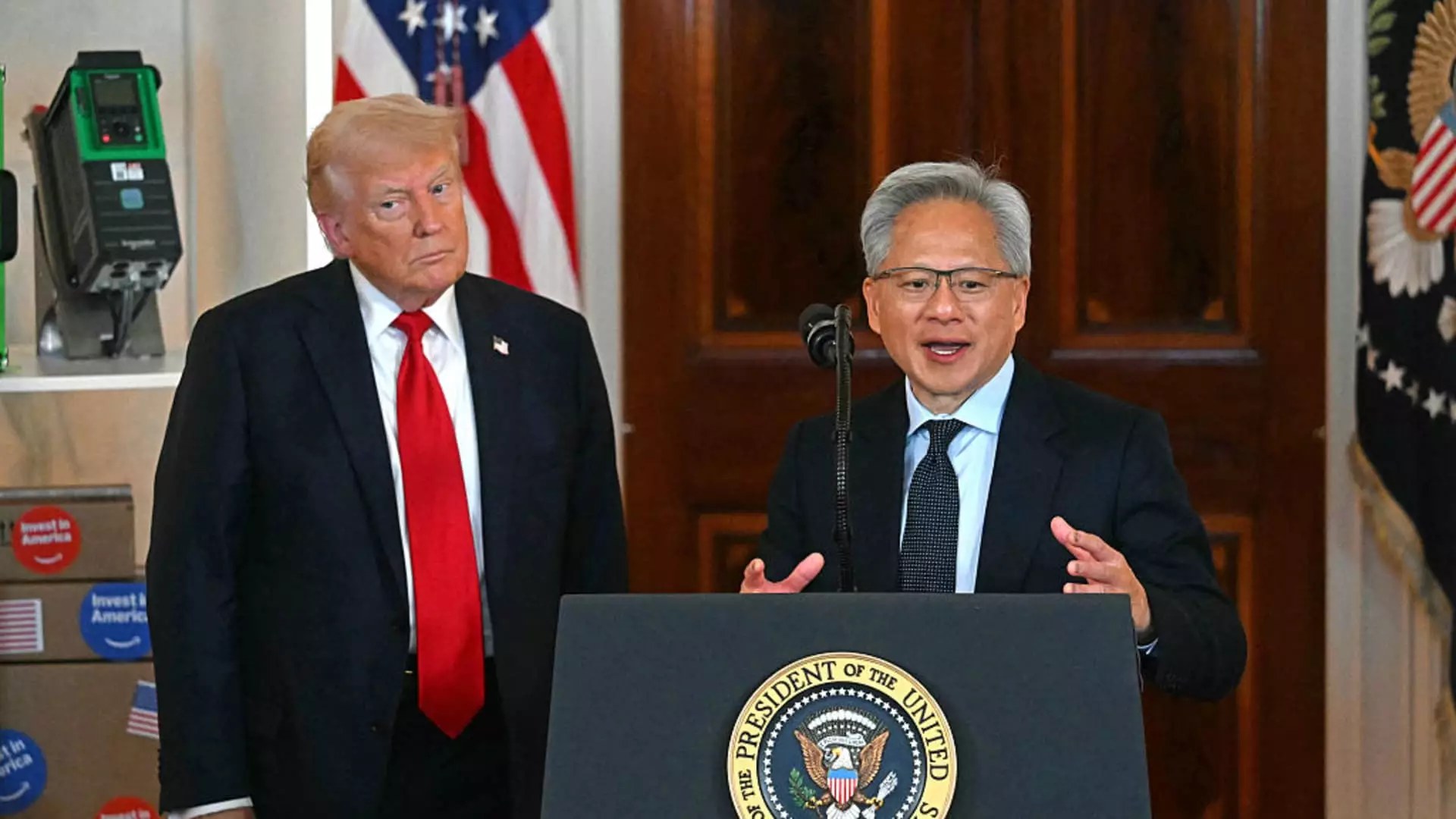
Recently, the U.S. government’s decision to permit major semiconductor firms like Nvidia and AMD to export advanced AI chips to China has sparked intense debate. Instead of viewing this as a strategic move to open markets or foster commercial growth, critics argue it jeopardizes America’s technological dominance and national security. The core concern lies in trading critical AI hardware—integral to military and advanced intelligence systems—under a revenue-sharing arrangement that many see as a dangerous giveaway of technological leverage.
This decision surfaced amidst a broader geopolitical landscape where technology is weaponized not only for economic gain but also for military supremacy. The notion of allowing our most advanced chips—such as Nvidia’s H20 and AMD’s MI308—to reach China, while extracting a mere 15% revenue cut, raises fundamental questions about the priorities of current U.S. policy. It shifts the conversation from safeguarding innovation to capitulating to economic interests, arguably at the expense of long-term strategic security. While proponents tout this as fostering trade and collaboration, skeptics view it as a reckless surrender of critical advantages that have historically kept the U.S. ahead in the tech race.
The Lobbying of Critics and Their Concerns
Six Democratic senators, led by prominent figures such as Chuck Schumer and Elizabeth Warren, publicly voiced their alarm through an open letter. They emphasized the importance of preserving the United States’ technological lead, warning that this deal—permitting revenue sharing in exchange for export licenses—might inadvertently empower China’s military and espionage sectors. This aligns with a longstanding narrative that advanced AI and semiconductors are not just commercial commodities but national security assets.
The senators’ core argument questions the wisdom of monetizing what should be viewed as a security asset—an approach that invites the perception of weakness at a time when geopolitical tensions are at an all-time high. Their plea for the administration to reconsider underscores the belief that the strategic sale of such advanced technology could tip the balance of power, especially in an era where AI-driven military systems are rapidly transforming warfare.
Meanwhile, Nvidia’s response dismisses fears that their chips could bolster China’s military. The company asserts that their products are primarily aimed at fostering innovation and supporting global developers rather than military applications. Yet, critics remain unconvinced, viewing such assurances as insufficient, given the opacity surrounding how exactly these chips are used and who might ultimately benefit.
Government, Industry, and the Global Response
The Trump administration’s stance appears to downplay critics’ warnings, framing the decision as a necessary component of maintaining economic momentum and technological leadership. Comparing the current scenario to previous administrations’ policies, officials suggested that concerns are exaggerated or politically motivated—resorting to inflammatory language about “selling out” American interests. This defensive posture reveals the intensifying pressure within government circles to balance economic diplomacy with strategic security.
Meanwhile, the geopolitical fallout is already materializing. Reports indicate that China is exhibiting reluctance or outright resistance to re-admitting advanced U.S. chips into its market. Chinese authorities, wary of dependency on foreign technology, are allegedly curbing orders and promoting self-sufficiency, thus creating a paradox where American exports intended to bolster trade may actually fuel domestic innovation within China.
The broader global semiconductor ecosystem is at a crossroads. As the U.S. loosens restrictions, other nations observe closely—some might follow suit, eroding the embattled lead the U.S. has maintained. Alternatively, Chinese restrictions might serve as a wake-up call for the U.S. to double down on its innovation policies rather than risk losing the edge entirely.
An Unsettling Future for U.S. Technological Leadership
This controversy exemplifies a fundamental tension in U.S. policy: the desire to stimulate economic growth versus the imperative to protect strategic interests. Allowing sales of AI chips—central to military and intelligence operations—opens the door to the possibility of espionage, technology transfer, or worse, weaponization of what was once considered purely commercial innovation.
By essentially monetizing critical national security assets, the U.S. risks undermining its own technological advantages. The revenue-sharing model, though seemingly trivial, could catalyze a significant decline in American influence over advanced AI technology. If China can develop its own capabilities or if other adversaries mimic this approach, the U.S. might find its strategic superiority permanently diminished.
Ultimately, this situation underscores a crucial reality: technological primacy is a moral and strategic battleground that cannot be sacrificed lightly. As policies shift to embrace short-term economic gains, the long-term costs—both in security and innovation—must be critically examined. The future of American leadership in AI and semiconductor technology depends on safeguarding those assets, rather than undermining them through risky, profit-driven compromises.
Leave a Reply