
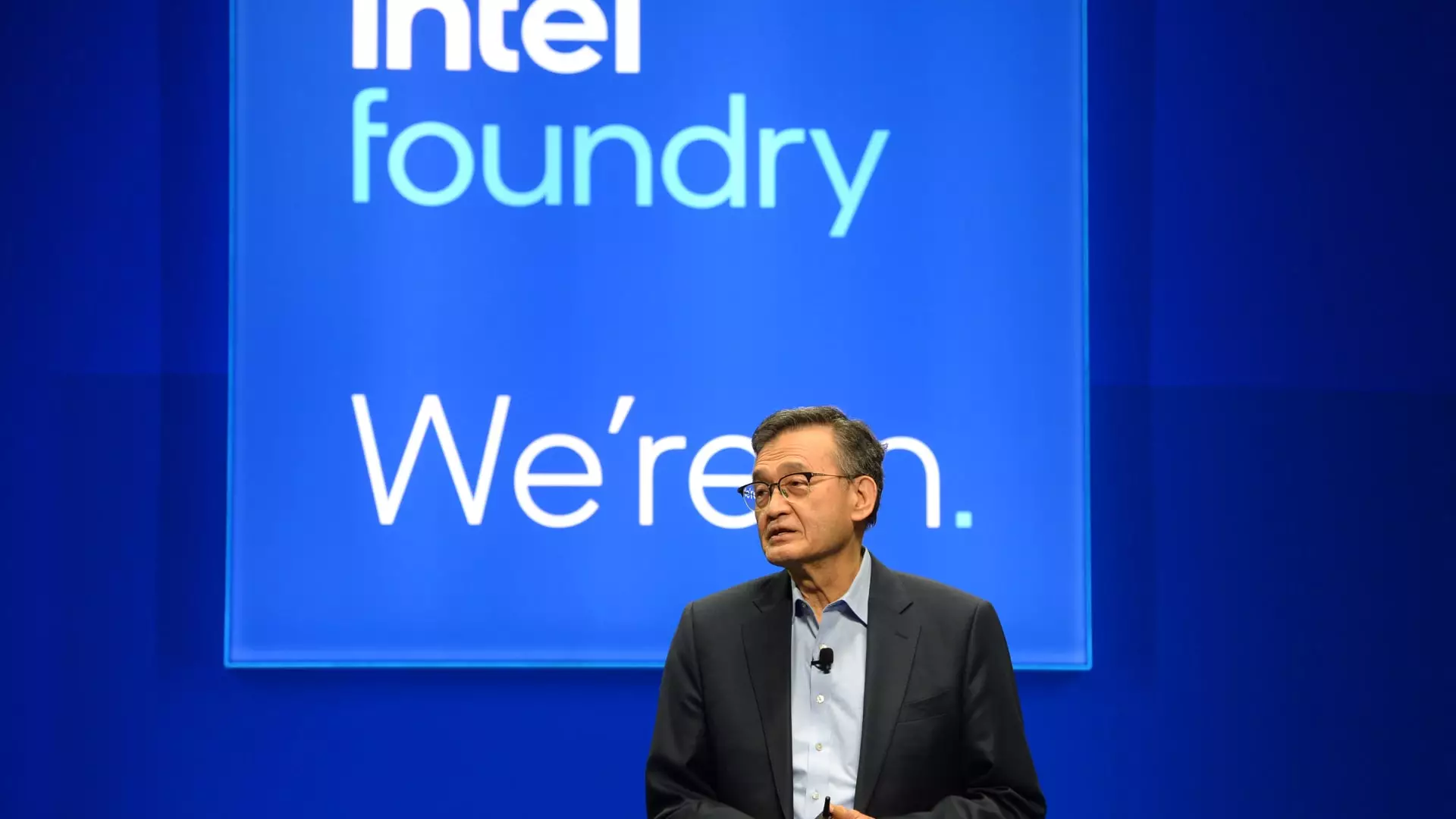
In an era where technological innovation is the currency of global competition, Intel’s recent decisions highlight a pivotal moment in its evolution. The chipmaker’s announcement to significantly cut foundry investments signals a dramatic reassessment of its strategy to regain footing in a landscape dominated by industry giants like TSMC and Samsung. Although the immediate market response was volatile—causing shares to plummet 9%—this pivot could be a calculated move towards sustainable growth and relevance in the semiconductor ecosystem. Intel’s decision to scale back its manufacturing ambitions and focus on securing external customers underscores an internal recognition that its previous approach may have been overly ambitious and misaligned with market realities.
What stands out is the underlying acknowledgment of systemic issues within Intel’s manufacturing and sales pipeline. The company’s struggles to attract external clients for its foundry services reveal both strategic miscalculations and a challenging market environment. Rather than persisting blindly with its own manufacturing initiatives, Intel’s leadership appears to be shifting towards a more cautious, demand-driven approach. This reevaluation could either serve as a stress test of its core competencies or a realization that diversification through external partnerships is essential for survival. The decision to potentially discontinue certain foundry projects signals a willingness to accept raw realities, even if it means abandoning previously favored growth avenues.
Leadership’s Candidness and the Cost of Overextension
CEO Lip-Bu Tan’s candid remarks about the company’s internal struggles speak volumes about the current turmoil; it is rare to see such blunt admissions from a CEO in the tech sector. Tan’s acknowledgement that the company’s factory footprint became “needlessly fragmented and underutilized” reveals a deeper systemic flaw—overexpansion driven by optimism rather than demand. This illustrates a broader lesson about the danger of rapid scaling without solidified market demand. The layoffs, which will cut 15% of the workforce, align with this new pragmatic approach, focusing on trimming excess and aligning infrastructure spending with realistic revenue prospects.
The company’s widening net loss, coupled with a substantial impairment charge, highlights the heavy toll of previous miscalculations. Yet, amidst these financial setbacks, there’s a potent undercurrent of resilience. By slashing costs and halting non-strategic projects, Intel is attempting to preserve capital for the long-term. This internal self-criticism and willingness to accept difficult adjustments reflect a mindset shift—no longer chasing thin future promises but building a foundation rooted in realistic expectations.
Challenges in the Artificial Intelligence Arena and Market Perception
The broader context complicates Intel’s revival narrative. While the company reports better-than-expected quarterly earnings, its inability to capitalize on the booming artificial intelligence market—a domain where firms like Nvidia lead decisively—remains a glaring weakness. Intel’s AI ambitions have so far been underwhelming, hampered by a lack of competitive edge or external partnerships that can catapult it ahead of the curve. The skepticism surrounding its foundry ambitions only exacerbates this issue, as investors question whether Intel can carve out a significant niche in manufacturing for other industry players.
Market share erosion and a decline of 60% in Intel’s valuation for 2024 mark a stark reality check. The company’s attempts at diversification and technological innovation seem to have fallen short, and its strategic pivot toward foundry services, rather than being a leap forward, may be viewed as a necessary but insufficient response. Analysts’ mixed reactions highlight a cautious optimism—while reducing foundry investments might be “positive,” the overarching concern remains whether Intel can regain momentum in core markets such as PC, data center, and AI processing.
Intel’s current crossroads exemplify the brutal realities of maintaining relevance in the high-stakes semiconductor industry. Its latest moves—cutting costs, redefining manufacturing priorities, and confronting internal inefficiencies—are undeniably bold. Such candor and willingness to confront difficult truths are commendable, yet they also underscore the colossal challenge ahead. The road to regaining industry leadership is fraught with uncertainties, not least because of fierce competition, rapidly evolving technology, and the need for strategic clarity.
Ultimately, Intel’s willingness to retool, accept failures, and focus on core strengths could be its salvation. However, the path forward demands more than cost-cutting and strategic recalibration; it requires inspiring confidence that the company can innovate and compete in markets where billion-dollar investments pace faster than ever. If Intel can harness this moment as an inflection point—learning from past overreach and embracing a more pragmatic, customer-centric approach—it may yet transform from a struggling legacy player into a resilient, formidable force in the global chip industry.
Leave a Reply