In the rapidly evolving landscape of artificial intelligence, the race for dominance is no longer confined to tech giants like OpenAI or Google. A quieter but equally revolutionary wave is emerging from Alibaba’s Qwen team, which has recently unleashed a flurry of groundbreaking models that challenge perceptions of what open-source AI can accomplish. This strategic pivot toward specialized, high-performance models marks a fundamental shift—not just in capabilities, but in the very philosophy of AI deployment. For years, the industry flirted with proprietary, API-restricted models, often trading control for convenience. Alibaba’s latest offerings, however, demonstrate a clear commitment to democratizing AI, empowering users and enterprises with tools that are both powerful and liberating.
The release of multiple models—including reasoning-focused, coding, and multilingual versions—illustrates a deliberate move away from monolithic stacks towards a modular ecosystem. What makes this development truly compelling is not just the raw benchmarks but the underlying vision of fostering transparency, accessibility, and full ownership. As a critic of AI’s closed-door approach, I believe Alibaba’s open licensing under Apache 2.0 signals a decisive step toward reshaping industry standards and reigniting innovation at the grassroots level.
Transformative Benchmarks and Benchmark Breakthroughs
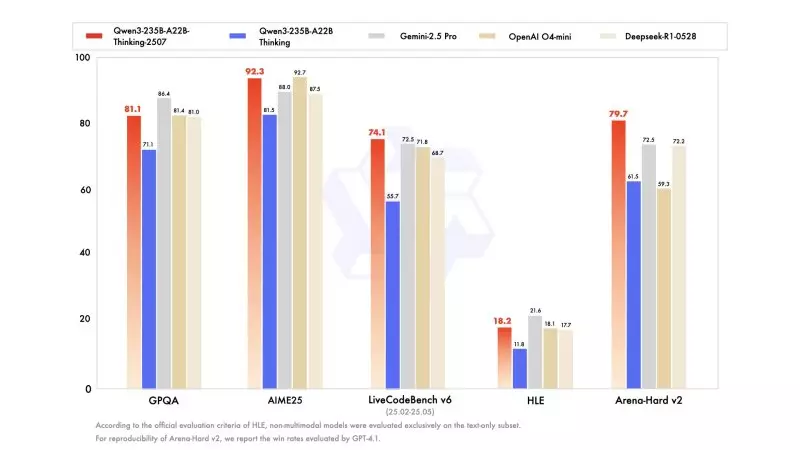
The core of Alibaba’s recent success lies in its high-stakes pursuit of performance excellence. The crown jewel, Qwen3-235B-A22B-Thinking-2507, exemplifies this ambition. Its ability to engage in “chains-of-thought,” reflecting a nuanced reasoning process, elevates it above many contemporaries. This model doesn’t simply spit out answers; it introspects, checks, and refines its own responses, mimicking a form of machine introspection that was previously considered a luxury reserved for proprietary giants.
When tested across industry-standard benchmarks like AIME25, Qwen’s reasoning prowess shines brightly, narrowly outperforming OpenAI’s GPT-4 mini and outperforming other open-source contenders like Gemini-2.5 Pro. Its performance on tasks demanding mathematical and logical reasoning—an arena where many models stumble—places it firmly at the frontier of AI capability. Notably, Qwen’s superiority on LiveCodeBench v6 reveals an impressive mastery over complex coding tasks, making it invaluable for development teams handling sophisticated software workflows.
Such benchmark results do more than bragging rights—they reveal the core potential of open-source models to match or even surpass proprietary systems in specific, high-demand areas. This surge indicates that open models can be not just viable alternatives but competitive frontrunners, provided they target the right use cases with engineering precision.
Strategic Shifts Toward Specialization and Transparency
A particularly insightful aspect of Alibaba’s approach is its architectural philosophy. Moving away from hybrid models that tangled reasoning and instruction in a single system, the company has begun specializing—training distinct models optimized for their intended tasks. This separation not only boosts performance metrics but also enhances consistency and clarity for users. No longer does one have to grapple with the nuisance of toggling modes; instead, users access models designed from the ground up for reasoning, coding, or translation.
This deliberate segmentation represents a maturation of the open-source AI movement. Instead of seeking a “jack-of-all-trades,” Alibaba focuses on creating masterful specialists. The result is a more predictable, reliable, and trustworthy AI infrastructure—attributes crucial for mission-critical enterprise deployments. Furthermore, the openness of these models, licensed under the permissive Apache 2.0 license, erodes the barriers that once limited widespread adoption. Companies can freely interpret, customize, and integrate these models into their proprietary workflows with full ownership—an empowering shift that challenges the proprietary dominance that has historically tethered AI innovation behind paywalls and API restrictions.
Empowering the Ecosystem with Versatility and Control
Alibaba’s diverse product lineup underscores its understanding of the multifaceted needs of modern AI applications. The release of Qwen3-Coder, built for code-centric workflows with a massive context window, pushes the boundaries of what open-source models can deliver in software development and automation. Similarly, Qwen3-MT’s multilingual capabilities open doors to global markets, enabling nuanced translation, localization, and domain-specific adaptations—features that are now impossible to ignore for international enterprises.
These models are not just technological novelties; they are strategic tools. Easy access via Hugging Face, ModelScope, and direct API integrations means that organizations — regardless of size — can embed cutting-edge AI into their daily operations without exorbitant licensing fees, restrictive controls, or vendor lock-in. The permissiveness of the Apache 2.0 license becomes a powerful lever for innovation, fostering a vibrant community that can improve, customize, and deploy models without legal or financial restrictions.
Moreover, the cost structures introduced—such as competitive token pricing and free tiers—lower the barrier to entry, making enterprise-grade AI accessible from startups to multinational corporations. The flexibility of running these models locally or via cloud solutions, coupled with advanced deployment tools like Qwen-Agent and compatibility with OpenAI APIs, bridges the gap between cutting-edge research and practical, scalable implementation.
Redefining the Future Trajectory of AI Development
What this all signifies is a profound philosophical and strategic moment. Alibaba’s Qwen models exemplify a future where AI development is not just driven by a handful of corporations wielding proprietary engines, but by an open, collaborative ecosystem that values transparency, customization, and control. This approach fosters a breed of AI that is more aligned with real-world enterprise needs—trustable, adaptable, and openly accessible.
While critics might argue that open models risk misuse or less refinement compared to proprietary counterparts, the ongoing performance gains and strategic deployment strategies suggest otherwise. The ability to customize, audit, and understand these models offers a level of assurance proprietary systems often cannot provide. In a world increasingly concerned with data privacy, fairness, and accountability, Alibaba’s open approach could redefine what it means to be at the frontier of AI.
In essence, Alibaba’s recent surge is not merely about launching models but igniting a paradigm shift—championing democratization and excellence, setting a new standard for what open-source AI can accomplish and urging the entire industry to rethink the balance between openness and performance.
Leave a Reply