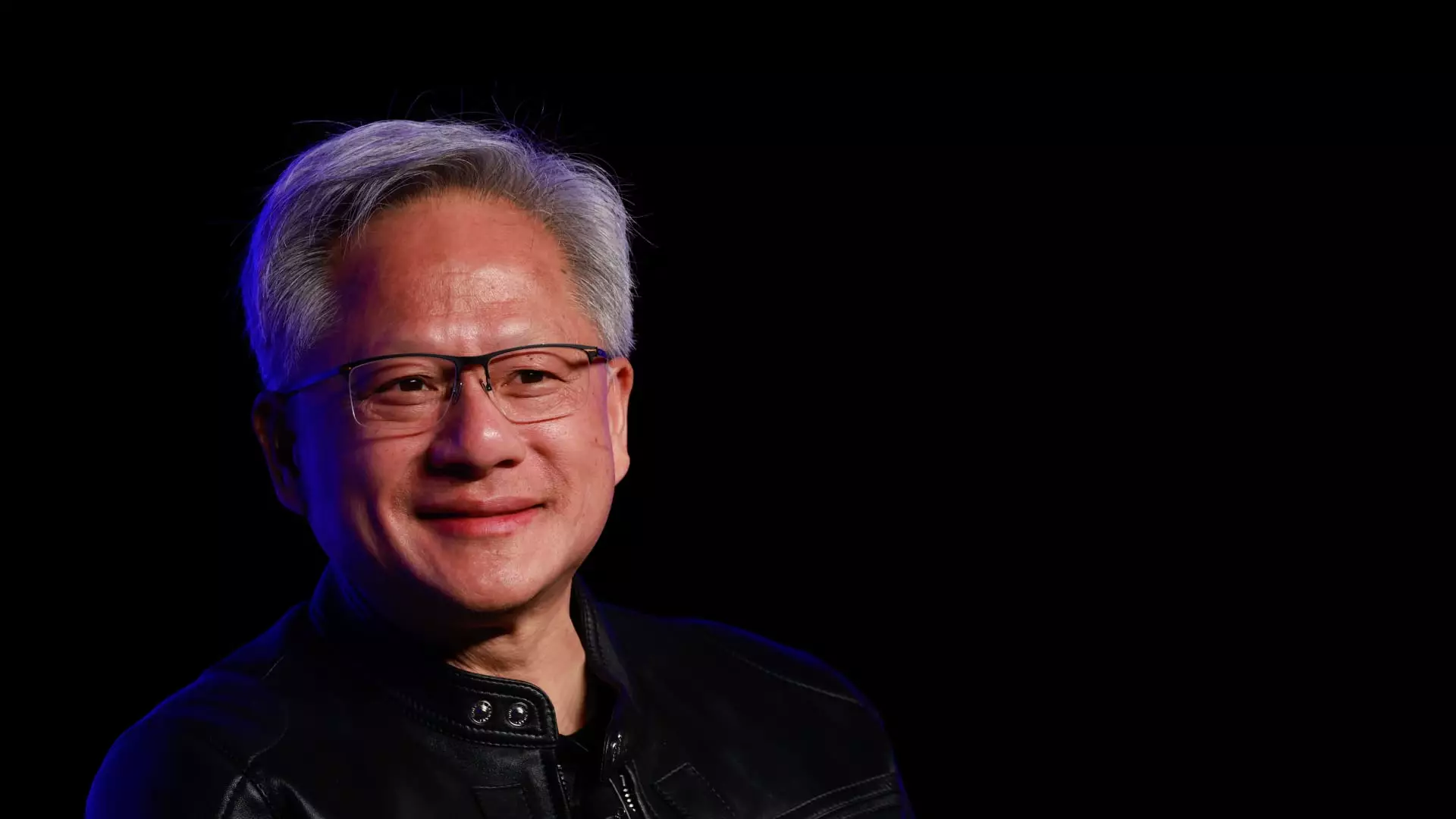
In the rapidly evolving landscape of technology, the words of Nvidia’s CEO, Jensen Huang, resonate powerfully. He recently described artificial intelligence as the “great equalizer” — a transformative force akin to a new programming language, dubbed ‘human.’ For decades, the barrier to entry in the world of computing was steep, accessible primarily to those who could navigate complex programming languages and intricate architectures. The narrative was one of exclusivity, where only the savvy few could leverage the power of technology to create meaningful output. However, Huang’s remarks at London Tech Week illustrate a monumental shift; technology is now bending to the will of its users, allowing anyone to communicate in their natural language — the language of humanity.
With the advent of conversational AI models, we have witnessed a radical democratization of programming skills. OpenAI’s ChatGPT skyrocketed into the public eye in 2022, boasting an astonishing 400 million weekly active users by February. This surge in interest is not merely a trend but a fundamental shift in how we interact with technology. People can ask AI systems simple questions, engaging in a dialogue that mirrors human conversation rather than interacting with a cold, impersonal machine. This creates an inviting environment where the power of complex programming can now be harnessed by virtually anyone, regardless of their technical background.
The Power of Conversational AI
Huang emphasizes that this democratization enables users to command AI with relative ease. Historically, programming languages like C++ or Python deterred many who lacked formal training. Instead of requiring users to learn syntax and structure, AI has ushered in an era where a straightforward dialogue can suffice. Huang used the example of asking an AI to write a poem about his speech — a task that was daunting for many before, now reduced to a simple request. “You say: You are an incredible poet … And I would like you to write a poem to describe today’s keynote,” he elaborated, demonstrating how conversational prompts can yield creative and sophisticated outputs, transforming the relationship between creator and machine.
This conversational approach holds profound implications for education and creativity, particularly among younger audiences. Children, naturally adept at communication, are embracing this technology with ease, and therefore, we are likely to see a new generation that views technology not as an obstacle but as a collaborative partner in creative endeavors. Huang’s insight should encourage educators and parents to exploit this shift, equipping children with the tools to engage with AI as a means of expression rather than a mere utility.
The Economic Implications
The implications of such accessibility extend beyond individual users; they ripple through the workforce, reshaping job dynamics across various industries. Companies like Shopify, Duolingo, and Fiverr are already integrating AI into their operational frameworks, recognizing its potential to augment human capabilities rather than replace them. The notion that AI could pose a threat to employment has dominated discussions, yet Huang’s optimistic viewpoint champions a different narrative. He encourages employees to view AI as an augmentation tool that can enhance their productivity and make them indispensable in their professional environments.
The surge in business users adopting AI, as evidenced by OpenAI’s announcement of 3 million paying users, reflects a growing acceptance of this technology as a fundamental asset in the workplace. Huang advocates for this evolution, urging individuals to embrace the technology’s capabilities. “This way of interacting with computers, I think, is something that almost anybody can do,” he notes, empowering users to seize this opportunity.
Navigating the Future with AI
As we navigate this transformative landscape, we must also consider the ethical dimensions accompanying AI’s ascent. While Huang paints an optimistic future of creativity and productivity, it is crucial to approach this technology with cautious enthusiasm. The potential for misuse or over-reliance on AI could yield unforeseen consequences. Therefore, fostering a culture of responsible AI use and understanding the nuances of machine-human interaction is paramount.
Imagining a future where anyone can communicate with technology in their own language is exciting, yet it necessitates a commitment to educating users on how to leverage these tools responsibly. As AI continues to advance at breakneck speed, the challenge lies in ensuring that its benefits are equitably distributed and that users are equipped not just to engage with AI, but to understand its far-reaching impact on society. The journey ahead is as thrilling as it is complex, and society must be both bold and wise in embracing this new frontier.
Leave a Reply