
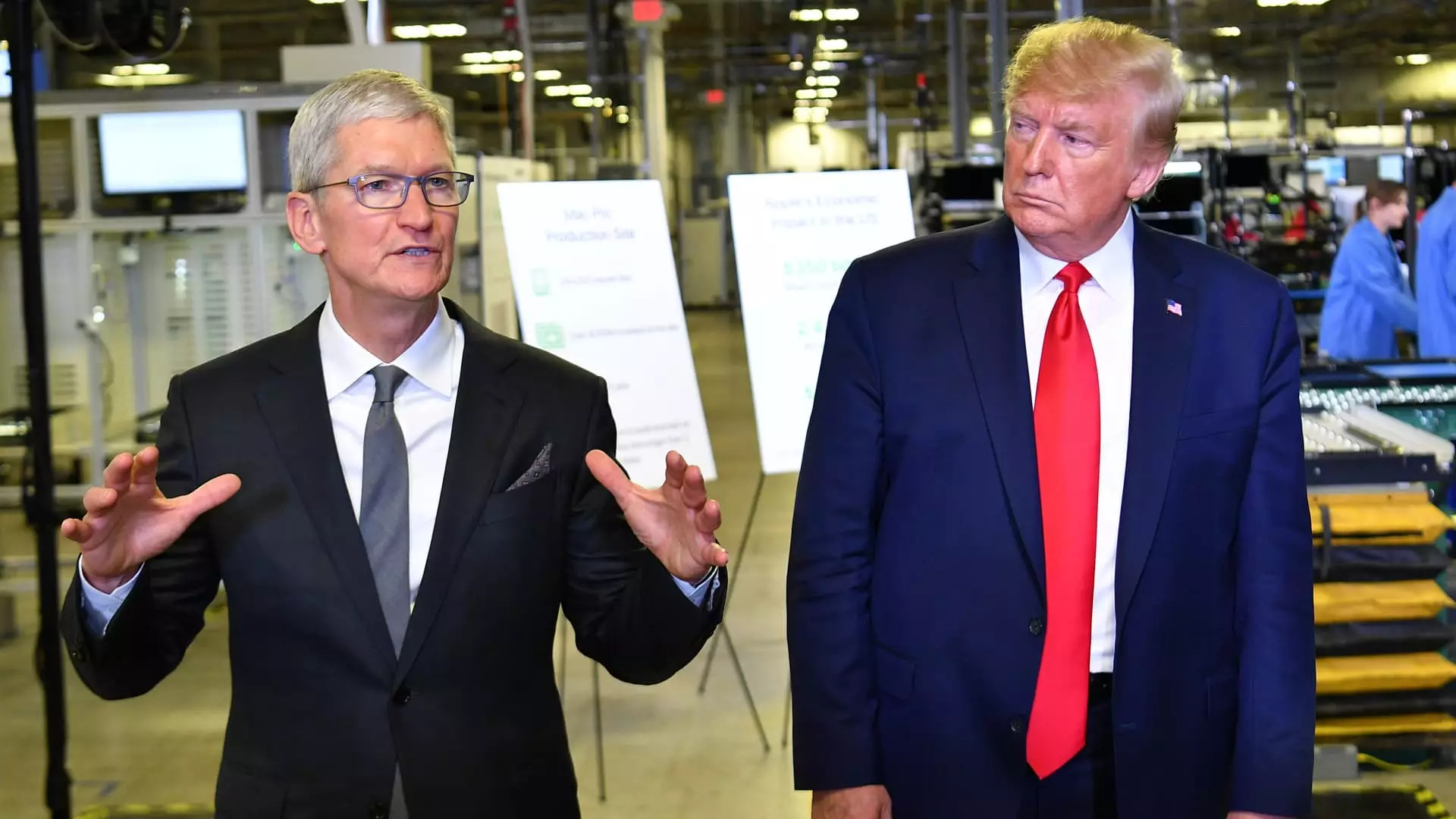
In a provocative move that could reshape the U.S. technology landscape, former President Donald Trump has taken aim at Apple, suggesting that the tech giant must produce its iPhones within American borders or face the repercussions of a hefty tariff surpassing 25%. This ultimatum, delivered through a post on Truth Social, underscores Trump’s ongoing push for increased domestic manufacturing and heightened scrutiny on corporations that opt for overseas production. The rhetoric surrounding this issue not only reverberates within the halls of tech giants and Wall Street but also sends shockwaves through consumer markets, forcing a reexamination of labor dynamics and profitability.
Trump’s unyielding demand for American production is both a reflection of his administration’s trade policies and a continuation of populist sentiments aimed at rejuvenating domestic labor. He stated unequivocally that if Apple chooses to manufacture elsewhere, they must brace themselves for the financial fallout—specifically, a 25% tariff on iPhones sourced from foreign lands. This declaration raises significant questions regarding the feasibility of meeting such demands without drastically inflating consumer prices.
The Economic Implications of Production Costs
Analysts are already projecting that relocating iPhone production to the U.S. could inflate the cost of Apple’s flagship device to staggering heights—upwards of $3,500, according to some estimates. For comparison, current retail prices hover around the $1,000 mark for the iPhone 16 Pro. The ramifications of such a price jump could displace millions of consumers eager to own the latest technology. One cannot help but wonder if this price surge, alongside the looming tariffs, is an unsustainable burden that may shift consumer behavior toward alternatives.
This financial strain comes at a precarious time for Apple, which is grappling with fluctuating demand in significant markets like China. With Trump’s avowed approach to tariffs and prior turbulent trade relations, fluctuations in production and distribution costs can create severe economic disarray. The calculus for Apple is complex; balancing corporate profitability with public sentiment and domestic job creation presents a formidable challenge.
Trump vs. Big Tech: A Shifting Relationship
The relationship between Trump and tech executives, particularly Apple’s CEO Tim Cook, has been historically nuanced. Once seen as collaborators, their camaraderie has evolved into a tense standoff, particularly with Trump ramping up his pressure on Cook to take more drastic steps towards U.S.-based manufacturing. There’s a sentimental irony to a situation where one of the world’s most recognized tech brands, a symbol of innovation and global reach, finds itself embroiled in a political tug-of-war.
Despite Cook’s previous contributions to Trump’s inauguration fund and their past cooperative initiatives, it appears the relationship has soured under the weight of larger strategic interests. The current ultimatum emphasizes a perceived betrayal of American manufacturing ideals. Should Apple resist these demands, it risks facing tariffs that could cripple its market position and redefine its operational strategy globally.
The Broader Trade Picture
Trump’s ire is not solely directed at Apple—his administration has targeted several major corporations in the past year, asserting his intent to realign trade practices and penalize companies for offshoring jobs. Nevertheless, his renewed focus on specific consumer goods indicates a potential escalation in trade tensions that could ripple across various sectors. Following his post regarding Apple, Trump further called for a ludicrous 50% tariff on European Union products, inciting fears of a potential resurgence of trade conflicts reminiscent of his presidency.
These developments could complicate future trade negotiations, as market players assess the legal framework and ramifications of such tariffs. A heightened tariff landscape might complicate Apple’s already tenuous equilibrium in the Asian market, impacting both supply chains and consumer dynamics across the globe. It highlights a volatility in international relations that could lead to significant disruptions not only for Apple but for countless industries integrating global supply chains.
Trump’s firm stance on Apple encapsulates a broader dialogue about trade, manufacturing, and American economic priorities. As the situation unfolds, the intersection of politics, consumer technology, and labor markets will undoubtedly serve as a crucible, testing the resilience and adaptability of both businesses and policymakers alike.
Leave a Reply